PATEL A LIFE by Rajmohan Gandhi
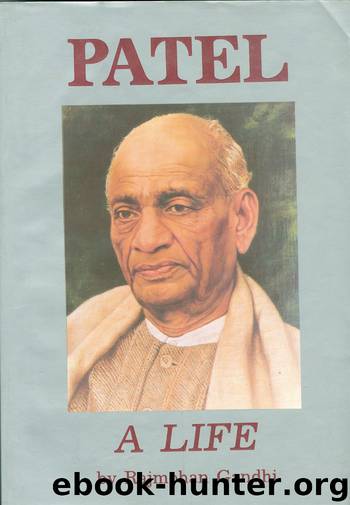
Author:Rajmohan Gandhi [Gandhi, Rajmohan]
Language: eng
Format: epub
Publisher: Navajivan Trust
Published: 0101-01-01T00:00:00+00:00
SIX
1939-45
THWARTED
CONGRESS had done well in office. Water was taken to dry villages. The debts of impoverished peasants were canceled. Temples were opened to untouchables. Land reforms were on the anvil when the Ministries vacated office. Bans on liquor, though controversial and hard to enforce, improved life in thousands of poor homes. “Domestic brawls have ceased, a sufficiency of food is available and the grip of the money-lender has relaxed,” the British Collector of Salem district in Madras presidency noted. The integrity, at the time, of most Congress Ministers and their pro-poor measures increased Congress’s prestige. Vallabhbhai vigilance and supervision had helped.
When the Ministries resigned, Jinnah, who had resented Congress’s power as much as Vallabhbhai had treasured it, told the country’s Muslims that they had experienced deliverance. We saw that though Congress neither desired nor created Hindu rule Muslims viewed it as a Hindu body. Patel tried to show that the perception was flawed. When a League committee headed by the Muslim ruler of Pirpur charged in January 1939 that Congress’s Ministries were depriving Muslims of government jobs and trying to Hinduism Muslims, Vallabhbhai marshaled a rebuttal.
It was not easy to pick holes in Congress’s refutation, and the League and Linlithgow rejected Congress’s proposal for an inquiry into the allegations by Sir Maurice Gwyer, Chief Justice of the Federal Court. The Viceroy admitted privately that “the Governors of the provinces concerned had brought no complaints of unjust treatment of the Muslims to his notice”; and Sir Francis Wylie, Governor of the C. P. from 1938 to 1940, felt that “the accusations of gross anti-Muslim bias on the part of the Congress ministries were... moonshine”. These were significant reactions, for Governors were the guardians of minority interests under the 1935 Act and entitled, in that role, to act independently of Ministers. Yet the image was stronger than the reality. Responding to Jinnah, large numbers of Muslims observed Deliverance Day on December 22. Though aware of the reality, the Raj gave its imprimatur to the League’s version. Zetland spoke of Congress as “a Hindu organization which should reach a settlement with the Muslim League”, and Patel’s suppressed indignation burst out:
We asked the Viceroy for the objectives of the war. We did not receive any direct reply but now are being... told to go and settle with the Muslims, that is, with the Muslim League. If we do succeed in coming to an agreement with them we shall probably be told, “Go and settle with the Indian princes.”
When that happens no doubt they will say, “What about the Europeans who have so many interests in the country and who have invested so much money?” Thus they wish to prolong the differences in this country, exactly as the monkey did in the story of the two cats that referred their dispute to it.... You (the British) are the real cause of all our quarrels. You introduced communal electorates...?
The Bombay flat of the widower Dahyabhai was, as noted earlier, Vallabhbhai home, and Manibehn’s. After seven years
Download
This site does not store any files on its server. We only index and link to content provided by other sites. Please contact the content providers to delete copyright contents if any and email us, we'll remove relevant links or contents immediately.
| Africa | Americas |
| Arctic & Antarctica | Asia |
| Australia & Oceania | Europe |
| Middle East | Russia |
| United States | World |
| Ancient Civilizations | Military |
| Historical Study & Educational Resources |
The Sympathizer by Viet Thanh Nguyen(4406)
The Rape of Nanking by Iris Chang(4229)
World without end by Ken Follett(3484)
Ants Among Elephants by Sujatha Gidla(3475)
Blood and Sand by Alex Von Tunzelmann(3212)
Japanese Design by Patricia J. Graham(3184)
The Queen of Nothing by Holly Black(2616)
City of Djinns: a year in Delhi by William Dalrymple(2565)
Foreign Devils on the Silk Road: The Search for the Lost Treasures of Central Asia by Peter Hopkirk(2474)
India's Ancient Past by R.S. Sharma(2464)
Inglorious Empire by Shashi Tharoor(2450)
Tokyo by Rob Goss(2438)
In Order to Live: A North Korean Girl's Journey to Freedom by Yeonmi Park(2396)
Tokyo Geek's Guide: Manga, Anime, Gaming, Cosplay, Toys, Idols & More - The Ultimate Guide to Japan's Otaku Culture by Simone Gianni(2382)
India's biggest cover-up by Dhar Anuj(2364)
The Great Game: On Secret Service in High Asia by Peter Hopkirk(2358)
Goodbye Madame Butterfly(2261)
Batik by Rudolf Smend(2193)
Living Silence in Burma by Christina Fink(2081)
